Ever thought about selling products online… without holding inventory, dealing with shipping, or investing thousands upfront?
That’s exactly what Print on Demand (POD) allows you to do.
Instead of dealing with bulk orders, storage, and logistics, you can focus purely on creating and selling — while a supplier handles everything behind the scenes. It’s one of the lowest-risk ways to start an online business today, especially if you’re just getting started or testing new ideas.
This guide will walk you through everything step-by-step — from understanding how POD actually works, to choosing the right niche, creating designs that sell, and launching your first store. We’ll also cover how to validate your ideas, drive traffic, and scale your products into a real, profitable business.
What We’ll Cover
What is Print on Demand?
Print on Demand is a business model where products are only created after a customer places an order. You design and sell products, while a third-party supplier handles printing, packaging, and shipping.
In simple terms, you’re not buying inventory upfront or holding stock. Instead, you’re acting as the creator and marketer, while a third-party supplier handles production and delivery.
This means:
- No bulk orders or storage costs
- No risk of unsold inventory
- No need to manage packaging or shipping
When someone buys from your store, the order is automatically sent to your Print on Demand supplier. They print your design onto the product, package it, and ship it directly to your customer — often under your brand.
What makes POD especially powerful is how accessible it is. You can start with just a design idea and a store, without needing a warehouse, equipment, or a big budget. It’s ideal for testing product ideas quickly and scaling what works.
For example, you could:
- Sell niche t-shirts for specific audiences (gym lovers, pet owners, entrepreneurs)
- Launch a poster brand using digital artwork (like your vintage travel posters)
- Create branded merchandise for a personal brand or content page
The real leverage in Print on Demand comes from creativity and marketing — not logistics. If you can create designs people resonate with and get them in front of the right audience, you can build a profitable store without ever touching the product.
How Print on Demand Works
Here’s how the process actually plays out in the real world:
- You create or upload a design (or choose from ready-made assets)
- You add it to a product (t-shirt, poster, hoodie, mug, etc.)
- You list it on your store (Shopify, Etsy, etc.) with pricing, mockups, and descriptions
- A customer places an order on your store
- The order is automatically sent to your POD supplier
- Your supplier prints your design onto the product
- They package and ship it directly to the customer under your brand
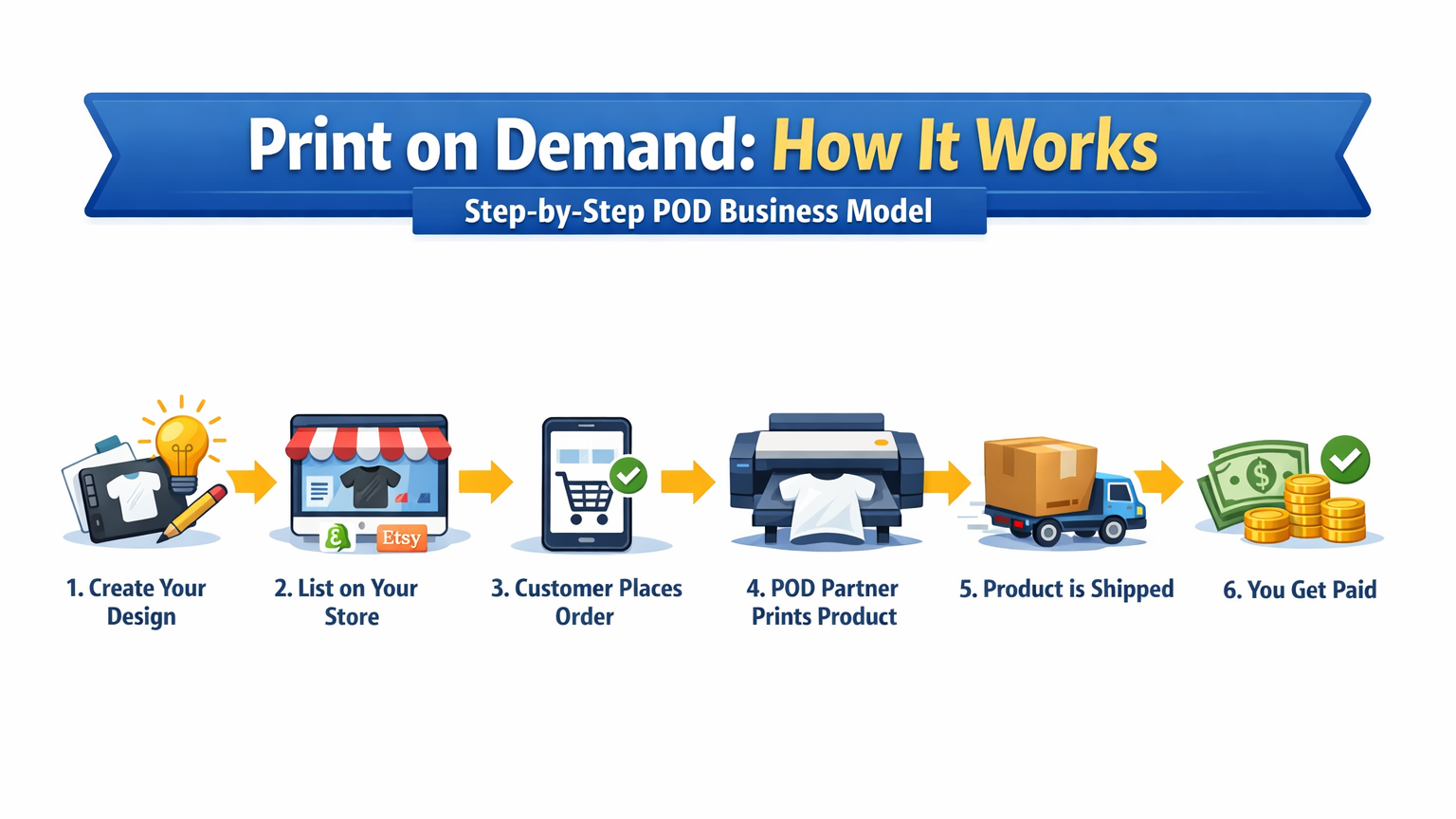
From your side, you’re mainly focused on three things: designs, listings, and marketing.
Simple on paper. But here’s what actually makes the difference:
- Your designs determine whether people stop scrolling
- Your product pages determine whether they buy
- Your traffic strategy determines whether anyone sees your products in the first place
This is why POD is often described as low-risk eCommerce — you’re not risking money on stock. But it’s not “set and forget.” The real work shifts to creativity, positioning, and getting your products in front of the right audience.
Have a look at this guide to find the best print on demand products to sell.

Once you understand that, everything clicks.
Pros & Cons of Print on Demand
✅ Pros
- No upfront inventory costs — You don’t need to spend thousands buying stock upfront. Products are only created when a customer orders, which keeps your startup costs extremely low and removes the need for storage or warehousing.
- Low risk to start — Because there’s no inventory to manage, your financial risk is minimal. You can launch with just a few designs, validate what works, and avoid being stuck with unsold products.
- Easy to test ideas quickly — You can launch new designs, niches, or products in minutes. This makes it perfect for experimenting, spotting trends, and doubling down on what actually sells without long production cycles.
- Scalable business model — Once you find winning products, you can scale fast without worrying about operations. Your supplier handles production and shipping, allowing you to focus on marketing, branding, and growing your store.odel
⚠️ Cons
- Lower profit margins — Because a third-party handles production and fulfillment, your base costs are higher compared to buying in bulk. This means your margins are tighter, especially in the beginning. To improve profitability, you’ll need to focus on strong branding, premium positioning, and increasing your average order value through bundles or upsells.
- Limited control over fulfillment — You’re relying on suppliers for product quality, printing accuracy, and delivery. If something goes wrong, it reflects on your brand, not theirs. This makes it important to choose reliable suppliers, order samples, and set clear expectations with customers.
- Competitive market — POD is easy to start, which means a lot of people are doing it. Standing out isn’t just about uploading designs anymore — it’s about niche selection, unique concepts, and strong marketing. The winners are usually those who build a brand, not just a product.
- Shipping times can vary — Since products are made to order, fulfillment and delivery can take longer than standard eCommerce. This can impact customer satisfaction if not communicated properly. Being transparent about shipping times and choosing suppliers with faster production can help manage expectations.
| Pros | Cons |
|---|---|
| No upfront inventory costs | Lower profit margins |
| Low risk to start | Limited control over fufilment |
| East to test ideas quickly | Competitive Market |
| Scalable business model | Shipping times can vary |
Best Print on Demand Platforms
To run a POD business, you really only need two core pieces — but how you set them up is what determines whether you make sales or not:
1. A store (your storefront) This is where customers discover your products, view your designs, and place orders. Think of it as your online “shop window.”
You’ve got two main routes here:
- Marketplaces (like Etsy) → Easier to start, built-in traffic, faster validation
- Your own store (like Shopify) → Full control, better branding, higher long-term potential
If you’re just starting, marketplaces help you get your first sales quickly. If you’re thinking long-term brand, owning your store gives you more control over pricing, customer data, and scaling.
2. A fulfillment provider (your backend engine) This is the company that actually brings your product to life. Once a customer orders, they handle:
- Printing your design onto the product
- Packaging it professionally
- Shipping it directly to your customer
The key here isn’t just picking any provider — it’s choosing one that aligns with your goals:
- Fast shipping (important for customer experience)
- Reliable print quality (protects your brand)
- Good product range (lets you expand easily)
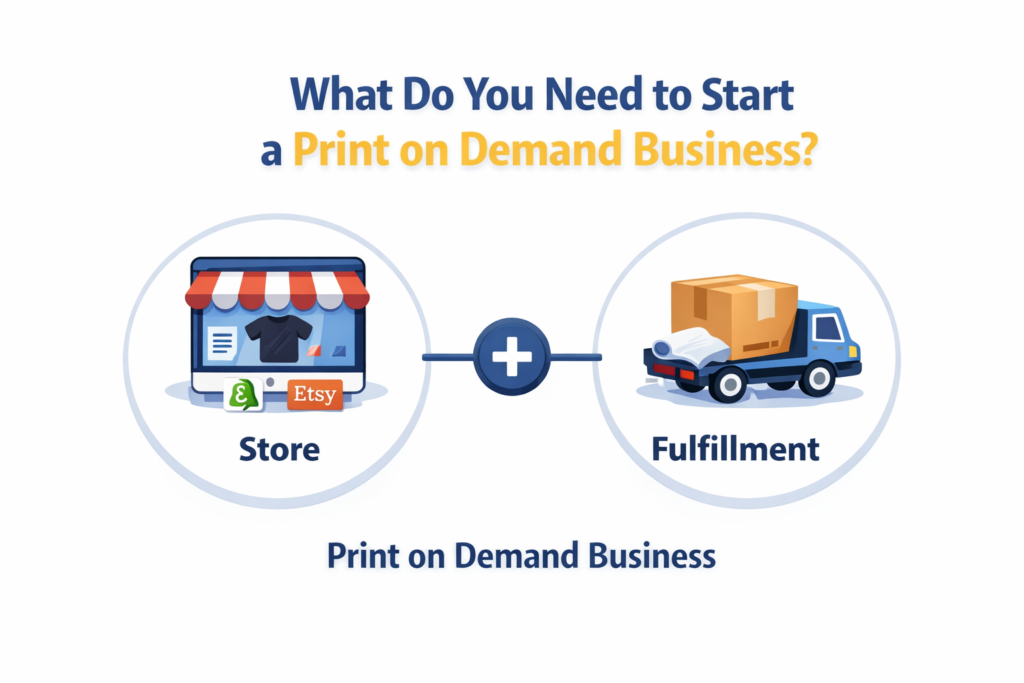
Here’s how it all connects (this is the part most beginners miss):
Your store + your fulfillment provider are just the infrastructure.
What actually makes money is the layer on top:
- Your niche (who you’re selling to)
- Your designs (what makes them stop scrolling)
- Your offer (why they should buy now)
- Your traffic (how people find you)
You can have the perfect setup technically… and still make zero sales if those pieces aren’t dialed in.
If you’d like to learn more, you can read this guide on the Best Print on Demand Platforms.
How to Choose a Profitable Niche
This is where most people get it wrong.
Instead of selling “cool designs,” think like a niche operator.
You’re not selling a design… you’re selling something that makes a specific person feel seen.
Focus on:
Specific audiences (dog owners, gym lovers, teachers)
Focus on clearly defined groups rather than broad categories. The more specific the audience, the easier it is to create designs that feel personal and relevant.
Example: First-time puppy owners, busy moms who train at home, burnt-out teachers
Strong identities (pride, humor, hobbies)
People are drawn to products that reflect how they see themselves or how they want to be seen. Designs should reinforce identity and self-expression.
Example: “I’m a disciplined gym-goer”, “I’m a chaotic cat mom”, “I’m a sarcastic developer”
Emotional triggers (funny, relatable, aspirational)
The most effective designs create an instant emotional reaction. They should feel relatable, make someone laugh, or tap into who they aspire to be.
Example: A shirt that makes someone think “that’s literally me” or “I need this”
Clear problems or desires
Strong niches are tied to real feelings, challenges, or goals. When a design speaks directly to a problem or desire, it becomes much easier to sell.
Example: Stress relief, staying motivated, feeling part of a group, expressing personality, or signaling status
Good niche examples:
- “Cat moms who work from home”
- “Gym beginners trying to stay consistent”
- “Developers with sarcastic humor”
- “Dog owners obsessed with their breed (e.g. Golden Retrievers)”
- “Entrepreneurs running on coffee and chaos”
- “Nurses on night shift”

Here’s a quick test for a strong niche: If you can picture exactly who would wear it, where they’d wear it, and why they’d buy it… you’re on the right track.
The more specific you get, the less competition you have… and the easier it is to create designs that actually sell.
Get a strong start by reading this guide on the How to Find Profitable POD Niches.
How to Create Designs (Even Without Skills)
You don’t need to be a designer to make this work.
What you actually need is the ability to spot what people resonate with… and turn that into something simple and visual.
Most winning POD designs aren’t complex. They’re clear, relatable, and instantly understandable. In many cases, a strong idea with basic text will outperform a “beautiful” design that doesn’t connect.
Think of it like this: Your job isn’t to impress designers… it’s to make someone stop scrolling and think, “that’s so me.”
Here’s how to approach it:
Start with the idea first
Before you open any design tool, ask:
- Who is this for?
- What are they into?
- What would make them laugh, feel seen, or want to show this off?
A simple phrase that hits the right emotion is more powerful than any graphic.
Keep designs simple
Clean text, minimal elements, and high contrast win almost every time. If someone can’t understand the design in 1–2 seconds, it’s too complicated.
Focus on clarity over creativity
Clarity sells. A straightforward message that’s easy to read will outperform something overly clever or abstract.
Test, don’t overthink
You don’t need the “perfect” design. Launch multiple variations, see what people respond to, and double down on what works.
Use tools to speed things up
Canva, AI tools, and pre-made design packs exist to remove the technical barrier. Use them to execute ideas faster, not to replace thinking.
At the end of the day, your advantage isn’t design skill.
It’s understanding people.
Here are your options:
Option 1: Use Canva
Canva is a great choice if you want to turn ideas into clean, sellable designs without getting stuck in complicated tools. It removes the technical barrier so you can focus on what actually matters—creating designs that connect with your niche and get people to stop scrolling. Whether you’re starting from scratch or building on templates, it’s one of the fastest ways to go from idea to live product.
Templates
Start with proven layouts instead of designing from scratch. Canva templates give you a structure for typography, spacing, and composition so your designs look clean even if you’re new. Don’t just use them as-is—tweak the text, colors, and positioning to match your niche and make the design feel original. Think of templates as a shortcut, not a crutch.
Text-based designs
This is where most beginners win. Simple phrases that hit an emotion (funny, relatable, identity-driven) outperform complex graphics. Focus on strong wording first, then pair it with clean fonts and high contrast so it’s easy to read at a glance. If someone can understand and relate to it in under 2 seconds, you’re on the right track.
Easy to learn
Canva has a low learning curve, which means you can go from idea to live product fast. You don’t need weeks of practice—just learn the basics: font pairing, alignment, spacing, and contrast. The goal isn’t to become a designer, it’s to execute ideas quickly and test what works. The faster you create, the faster you learn what actually sells.
Option 2: Use AI Tools
AI tools make sense when you want to move faster without sacrificing creativity. Instead of starting from scratch every time, they help you generate ideas, explore different styles, and turn simple concepts into multiple design variations in minutes. Used properly, they don’t replace your thinking—they amplify it, helping you test more, create more, and find what actually works much quicker.
Generate ideas quickly
AI helps you break out of creative blocks fast. Instead of staring at a blank screen, you can generate dozens of niche-specific phrases, slogans, and concepts in seconds. Use it to explore angles you wouldn’t normally think of, then refine the best ones into designs that actually resonate.
Create unique styles
AI can produce visuals and design directions that feel different from typical template-based work. This gives you an edge, especially in saturated niches. The key is to guide the output with clear prompts so your designs still feel intentional and aligned with your audience.
Speed up production
Once you have a winning idea, AI lets you turn it into multiple variations quickly. Different colors, layouts, phrases, and formats can all be generated and tested without starting from scratch each time. This makes it easier to launch more products, test faster, and find what sells.
Option 3: Buy Design Packs
Most beginners don’t start from scratch—they start with pre-made design packs. These give you instant access to ready-to-use designs so you can skip the learning curve and focus on getting products live. Instead of spending hours figuring out what to create, you’re starting with assets that are already built to sell, making it one of the fastest ways to launch and test your store.
Faster launch
Skip the blank-page problem and go straight to selling. With pre-made designs, you can upload products, set up your store, and start testing ideas within hours instead of spending days designing from scratch.
Proven styles
These designs are based on what already works. Instead of guessing what might sell, you’re starting with visuals and concepts that have demand, which gives you a much higher chance of getting early traction.
Less guesswork
You’re not trying to figure everything out from scratch. The niche, style, and direction are already there—you just focus on listing, positioning, and marketing. This lets you move faster and make decisions with more confidence.
More time for marketing
Design is only one piece of the puzzle. Using pre-made packs frees up your time so you can focus on content, testing ads, and actually getting traffic to your store—the part that drives sales.
Easy to expand
Once you find a design or style that works, you can quickly build variations (colors, quotes, formats) and scale your product range without starting over each time.
Beginner-friendly
You don’t need design skills to get started. This lowers the barrier to entry and helps you build momentum early, which is key in Print on Demand.
Setting Up Your Store
You have two main paths:
Option 1: Shopify Store
Shopify is a good option for anyone who wants to build a real brand around their print on demand business, not just list products and hope for sales. If you like the idea of having your own website, controlling how everything looks and feels, and creating a proper customer journey, this is for you. It’s especially suited for creators, freelancers, and beginners who are thinking long-term—people who want to test ideas, run ads, build an audience, and turn a simple product into a scalable business. If you’re willing to put in a bit more effort upfront in exchange for more control, flexibility, and higher profit potential over time, Shopify is the better path.
Full control over your store, customer experience, and data.
You’re not limited by marketplace rules, which means you can experiment with pricing, offers, upsells, and funnels freely.
Stronger, more recognisable branding.
Your store looks and feels like a real brand, not just another listing. This builds trust over time and makes it easier for customers to remember you and come back.
Long-term scalability.
You’re building an asset you own. As your traffic grows (through content, ads, or SEO), your store becomes more valuable and easier to scale without relying on a platform’s algorithm.bility
Option 2: Etsy Store
Etsy is a good choice for beginners who want to start quickly without building everything from scratch. If you don’t want to deal with setting up a full website, worrying about design, or learning too many technical tools upfront, Etsy gives you a simple way to get your products live and in front of real buyers fast.
It’s especially suited for people who want to test ideas, validate designs, and get early sales without needing traffic of their own. Instead of figuring out marketing from day one, you can tap into Etsy’s existing audience and see what people are already searching for and buying.
This path works well if your goal is to learn the basics of print on demand, understand what sells, and build momentum quickly. You’re trading some control and branding for speed and simplicity—which, for many beginners, is exactly what you need to get started.
Built-in audience
You’re not starting from zero. Etsy already has millions of buyers actively searching for products like yours, which means you can get visibility without building your own traffic first. If your listing is optimized (keywords, images, pricing), it can start showing up in search relatively quickly—something that’s much harder with a brand-new website.
Easier to start
No need to worry about setting up a full website, hosting, or complex integrations. You can create an account, upload your designs, connect a print provider, and go live in a few hours. This simplicity removes a lot of the friction that stops people from starting, so you can focus on getting products out instead of getting stuck in setup.
Faster validation
Etsy is one of the quickest ways to test whether your ideas actually have demand. You can launch multiple designs, see which ones get views, favorites, and sales, and double down on what works. Instead of guessing what might sell, you’re getting real market feedback early—saving you time, money, and effort in the long run.
What matters most:
What really matters is keeping your product pages simple, clear, and easy to trust. When someone lands on your page, they should immediately understand what you’re selling and why it’s worth buying. Clean layouts, high-quality images, strong, keyword-focused titles, and straightforward descriptions remove friction and make decision-making easy. You don’t need anything complicated—just a page that looks professional, communicates value quickly, and gives the buyer confidence to click “buy.”
Read the guide: How to Start a POD Store on Etsy.
Pricing & Profit Margins
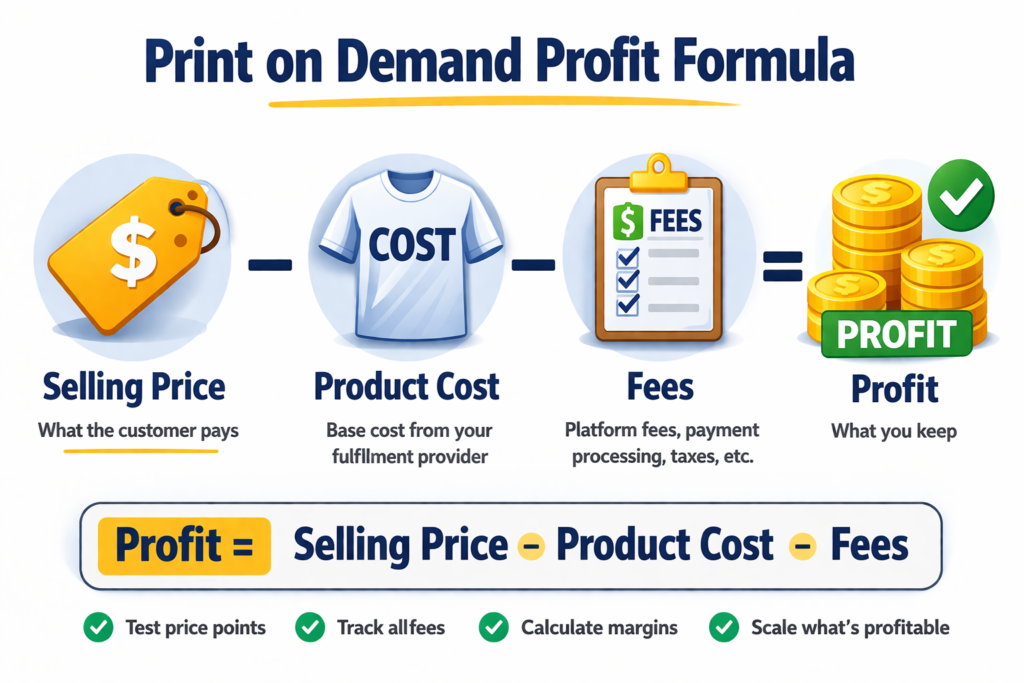
Your profit isn’t just the difference between what you charge and what the product costs—it’s what’s left after everything is accounted for.
Your profit = Selling price – product cost – fees
Where this gets real:
- Product cost → What your print provider charges (includes base product + printing)
- Fees → Platform fees (Etsy/Shopify), payment processing, transaction fees, and sometimes shipping
If you ignore fees, you’ll think you’re making more than you actually are.
Example (more realistic):
Product cost: $10
Selling price: $25
Platform + payment fees: ~$3–$5
Actual profit: ~$10–$12
Now you’re not just guessing—you’re pricing with clarity.
What most beginners get wrong:
They price too low to “get sales”… but end up with no real profit.
Low prices also make your product look cheap and harder to scale with ads later.
How to price smarter:
- Aim for healthy margins (30–50%+) so you have room for ads, discounts, and growth
- Factor in paid ads early (even if you’re not running them yet)
- Price based on value, not just cost — niche, design quality, and branding matter
- Use psychological pricing (e.g. $24.99 instead of $25)
- Test different price points — sometimes higher prices convert better
Simple rule:
If you can’t afford to run ads or offer a discount at your current price, your margins are too tight.
Pro tip:
Bundle products (e.g. “Buy 2, get 1 free” or themed collections). Your cost increases slightly, but perceived value jumps—this is one of the easiest ways to increase average order value without needing more traffic.
How to Market Your POD Store
This is where things actually start to click. You can have great designs and a clean store, but without marketing, nothing moves. This is the part that gets your products seen, clicked, and bought. The goal isn’t to be everywhere—it’s to show up consistently where your audience already spends time and give them a reason to care.
Marketing is also where you gather real data. You start seeing what people engage with, what they ignore, and what actually converts into sales. That feedback is what helps you refine your designs, improve your listings, and double down on what works.
Think of marketing as testing, not just posting. Every piece of content is an experiment.
Organic Channels:
Organic content is the easiest way to start because it doesn’t require a budget—just consistency and a willingness to learn.
TikTok is one of the fastest ways to get traction, even with a new account. Short, simple videos showing your product, a message on the design, or a relatable scenario can quickly reach thousands of people. You don’t need high production—raw, natural content tends to perform better.
Pinterest works differently. It’s less about going viral and more about long-term visibility. Your pins can show up in search for months, even years. This makes it perfect for print on demand because your designs can keep getting traffic long after you post them.
Instagram helps build trust and brand identity. While growth can be slower compared to TikTok, it’s where people go to validate your brand. Clean visuals, consistent posting, and showing your products in context (lifestyle, mockups, real use) make a big difference.
Paid Channels:
Paid ads allow you to speed things up once you have an idea that’s already working.
TikTok ads are a great starting point because they’re relatively low-cost and align well with the type of content that performs organically. If a video does well organically, you can turn it into an ad and scale it.
Read the guide: TikTok Marketing for Print on Demand.
Meta ads (Facebook and Instagram) are better for scaling once you understand your audience and have a proven product. They offer more targeting options and are powerful for retargeting people who have already interacted with your store or content.
The key with paid ads is not to guess. Start with content that already performs well organically, then put money behind it.
What works best:
Simple product videos consistently outperform overcomplicated content. Show the design clearly, use clean mockups or real-life examples, and make it obvious what the product is within the first few seconds.
Relatable content connects faster than generic promotion. Designs that reflect emotions, humor, identity, or everyday situations tend to get shared and saved more often.
UGC-style content (user-generated content) builds trust because it feels real. Even if you create it yourself, the goal is to make it look like something a normal person would post, not a polished ad. This lowers resistance and makes people more likely to engage.
You don’t need to reinvent the wheel. Find a format that works, repeat it, and iterate. The stores that grow are the ones that stay consistent, test often, and improve based on real feedback rather than guessing.
Scaling & Automation
Once you start getting consistent sales, the goal shifts from “testing” to “doubling down on what works.”
- Add more designs based on your best performers (don’t guess — iterate on proven ideas)
- Expand your product range (same winning designs on hoodies, mugs, phone cases, etc.)
- Automate workflows (order routing, mockups, product publishing, customer emails)
- Outsource design work so you can focus on growth instead of production
- Start building a simple content system to consistently drive traffic
- Reinvest profits into ads to scale what’s already converting
At this stage, you’re no longer just running a store — you’re building a system.
Eventually, your role becomes more about identifying winning products, scaling traffic through organic and paid methods and managing systems and people instead of doing everything manually, unless you enjoy creating your designs.
Common Mistakes to Avoid
Choosing a broad niche (trying to sell to everyone usually means you resonate with no one — go specific so your designs feel made for a particular group)
Overcomplicating designs (simple, clear designs tend to convert better — if someone can’t understand it in 2 seconds, it’s too complex)
Ignoring marketing (great designs don’t sell themselves — content, distribution, and consistency are what actually drive traffic and sales)
Giving up too early (most winning products come after multiple tests — treat this like a process, not a one-shot attempt)
Copying competitors instead of differentiating (use competitors for inspiration, but add your own angle, humor, or message so people have a reason to choose you)ferentiating
Final Thoughts
Print on Demand isn’t a “get rich quick” model.
But it is one of the easiest and most accessible ways to start an online business today — especially if you’re starting from zero.
I’ve personally used this model as a digital artist in the past, and it’s one of those things that just makes sense. You create once, upload, and let the platforms handle production and fulfilment. No inventory. No upfront costs. Just your ideas turned into products.
That’s why I genuinely see this as an evergreen model. Trends will change, platforms will evolve, but people will always buy designs that speak to them — whether that’s humor, identity, hobbies, or aesthetics.
If you focus on:
- A clear niche (so your designs feel made for someone, not everyone)
- Simple designs (fast to create, easy to understand, and often higher converting)
- Consistent marketing (content is what actually drives traffic and sales)
You’re not just “trying POD”… you’re building a system.
And the real win with this model?
It compounds.
One design turns into five.
Five turn into fifty.
Fifty turn into a store that’s actually getting traction.
Stick with it, treat it like a process, and you can build something that grows over time.
Next Steps
If you want to get started faster:
👉 Start with a niche
👉 Launch 5–10 products
👉 Focus on content (not perfection)
Start Your Print on Demand Business Faster
If you want to skip the trial-and-error phase:
- Focus on marketing from day one
- Use ready-made designs
- Follow a proven structure
Access this vintage poster bundle to get started.
Frequently Asked Questions About Print on Demand
What is the best platform for print on demand?
The best platform depends on your goals. Platforms like Etsy are great for beginners because they have built-in traffic, while Shopify is better for building a long-term brand with full control.
Can you really make money with print on demand?
Yes, you can make money with print on demand, but success depends on choosing the right niche, creating designs people connect with, and consistently driving traffic to your store.
How much does it cost to start a print on demand business?
You can start with very little money. Many people begin with under $50 by using free design tools and platforms like Etsy. Costs increase if you use paid tools or run ads.
Is print on demand saturated?
Print on demand is competitive, but not saturated. New sellers succeed by focusing on specific niches, unique ideas, and strong marketing rather than generic designs.
Do I need design skills to start print on demand?
No, you don’t need design skills. Many successful stores use simple text-based designs, Canva templates, AI tools, or pre-made design packs.
How long does it take to get your first sale?
This varies. Some stores get sales within days (especially on Etsy), while others take weeks. The key factors are niche selection, product quality, and how much traffic you generate.
What products sell best in print on demand?
Popular products include:
T-shirts
Hoodies
Posters
Mugs
Phone cases
However, the niche matters more than the product itself.
Do I need to hold inventory?
No. One of the biggest advantages of print on demand is that products are only created after a customer orders, so you don’t need to hold inventory.