Starting freelance work feels exciting. Until you get stuck at the beginner level.
You finally have freedom. You can choose your clients, set your schedule, and build something that feels like yours. But for many people, that excitement turns into frustration faster than expected.
Months pass. Income stays inconsistent. Clients are difficult to find. Confidence drops. Instead of growing, many freelancers stay stuck at beginner level for years.
This is not usually because they lack talent.
Most of the time, the problem is strategy.
Understanding why freelancers fail is the first step to avoiding the same mistakes. The gap between beginner freelancers and sustainable freelancers is often not skill—it is mindset, systems, positioning, and consistency.
Freelancing in 2026 is full of opportunity, but it is also more competitive than ever. If you want to grow, you need more than motivation. You need clarity.
You can find more practical freelance growth strategies at flows4 and creator resources at the flows4 store.
If you’d like to learn more about freelancing, you can check out the full freelancing guide.

Mistake 1: Treating Freelancing Like a Hobby Instead of a Business
One of the biggest freelance mistakes is approaching freelancing casually.
Many beginners think good work alone will bring clients. They focus only on the service they offer and ignore the business side completely.
They do not track leads. They do not follow up. They do not have pricing systems. They wait for work instead of building predictable ways to attract it.
This is one of the main reasons why freelancers struggle.
Freelancing is not just about doing the work. It is also about sales, positioning, operations, and client relationships.
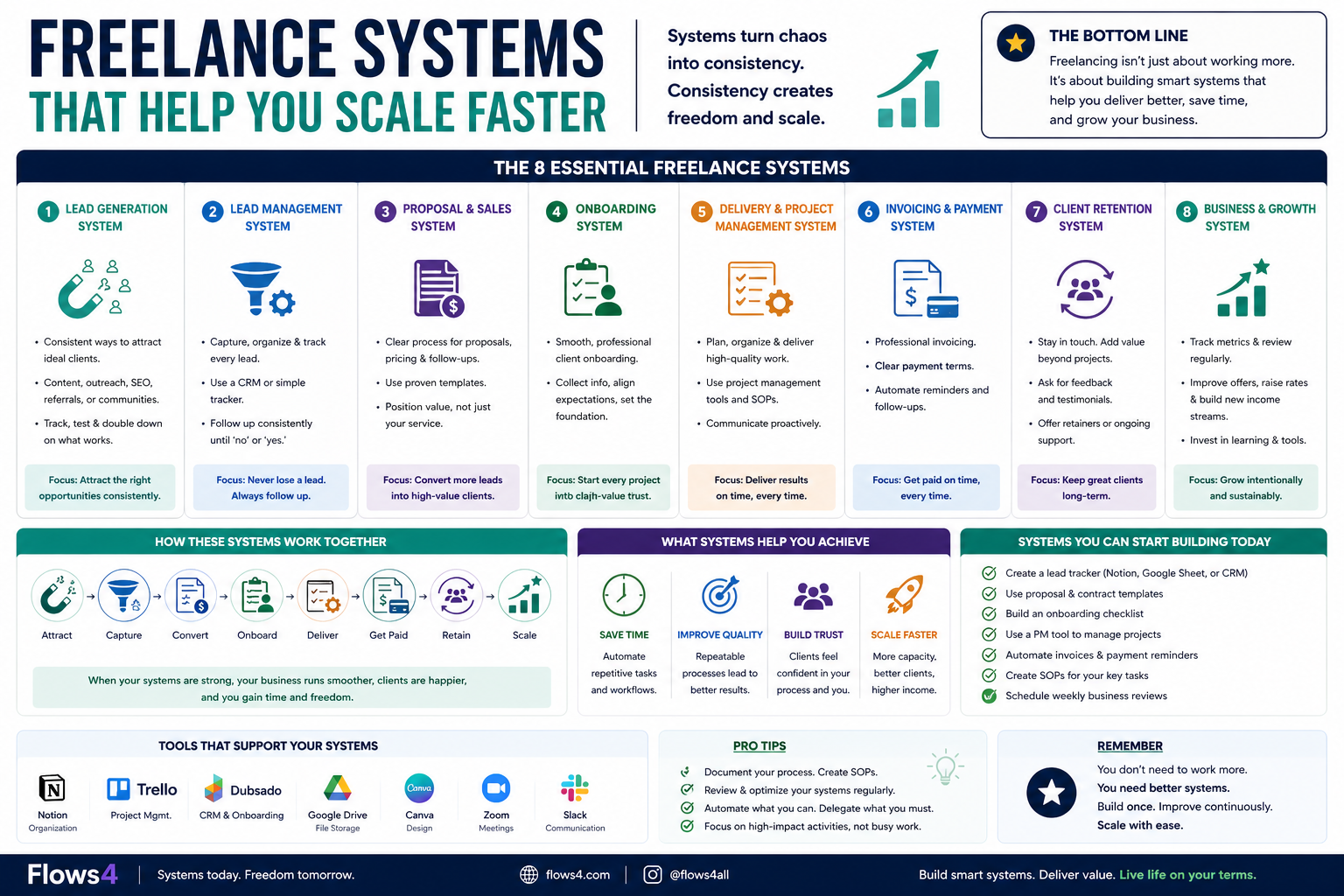
If you want consistent income, you need systems.
This is why building strong workflows matters. Our guide on freelancing systems explains how freelancer systems create structure and help you scale faster.
Without systems, every week feels like starting from zero.
That is not freedom. That is survival mode.
Mistake 2: Trying to Serve Everyone
Another major beginner freelancer problem is being too broad.
Many freelancers say things like:
“I do social media, websites, branding, SEO, content writing, and ads.”
They believe offering everything increases their chances of getting hired.
Usually, it does the opposite.
Clients trust specialists faster than generalists.
When your offer is unclear, buyers hesitate. They cannot quickly understand what problem you solve or why they should choose you.
Freelance growth mistakes often begin with weak positioning.
You do not need to be limited forever, but in the beginning, clarity wins.
It is easier to get your first strong clients when your offer is simple and specific.
For example:
Instead of “I build websites,” say “I build lead-generating WordPress websites for service businesses.”
Specific offers create stronger trust and better pricing power.
That is how freelancers move beyond beginner level.
I’ve written a guide on how to brand yourself if this is something you struggle with.
Mistake 3: Focusing on Platforms Instead of Relationships
Many beginners believe success depends entirely on platforms like Upwork, Fiverr, or social media.
While platforms can help, they are not the business.
The real business is relationships.
Freelancers who grow understand that trust creates repeat work.
They focus on referrals, strong client experiences, follow-ups, and reputation.
They do not just chase new leads—they build long-term relationships.
This is where many freelancing mistakes in 2026 happen.
People spend hours optimizing profiles but ignore communication, professionalism, and client retention.
A single happy client can create years of income through repeat work and referrals.
A strong first impression matters.
A strong final impression matters even more.
If you are still working on landing your first project, our guide on /how-to-find-first-freelance-client/ is a good place to start.
Mistake 4: Waiting for Confidence Before Taking Action
Confidence is one of the biggest traps.
Many beginner freelancers wait until they feel “ready.”
They delay outreach because their portfolio feels incomplete. They avoid raising prices because they feel inexperienced. They postpone content because they think they need more authority first.
This creates a loop.
No action means no results. No results means no confidence.
The cycle continues.
Why freelancers fail often comes down to hesitation, not ability.
Experienced freelancers are not fearless. They are simply used to acting before certainty.
They send proposals before they feel perfect. They improve through repetition. They learn by doing.
Growth comes from movement.
Not preparation without action.
This is also why staying visible matters. Sharing your work and learning publicly helps build authority over time. You can see creator-focused examples on our social media.
The goal is progress, not perfection.
Mistake 5: Ignoring Long-Term Business Building
Many freelancers think only about the next invoice.
That mindset keeps them small.
Sustainable freelancers think beyond the next project.
They build content. They create systems. They collect testimonials. They improve onboarding. They turn services into products. They create assets that keep working even when they are offline.
This is how freelancing becomes a real business.
Not just active income—but leverage.
Freelance mistakes are often short-term decisions repeated for too long.
If you are always starting over, growth becomes exhausting.
Long-term thinking changes everything.
The goal is not to stay busy.
The goal is to build something that compounds.
Final Thoughts
Most freelancers do not stay stuck because they are untalented.
They stay stuck because beginner habits create beginner results.
They treat freelancing like a side hobby. Their offers are unclear. They depend too much on platforms. They wait too long to act. They ignore systems and long-term growth.
These are the real reasons why freelancers struggle.
The good news is that every one of these problems can be fixed.
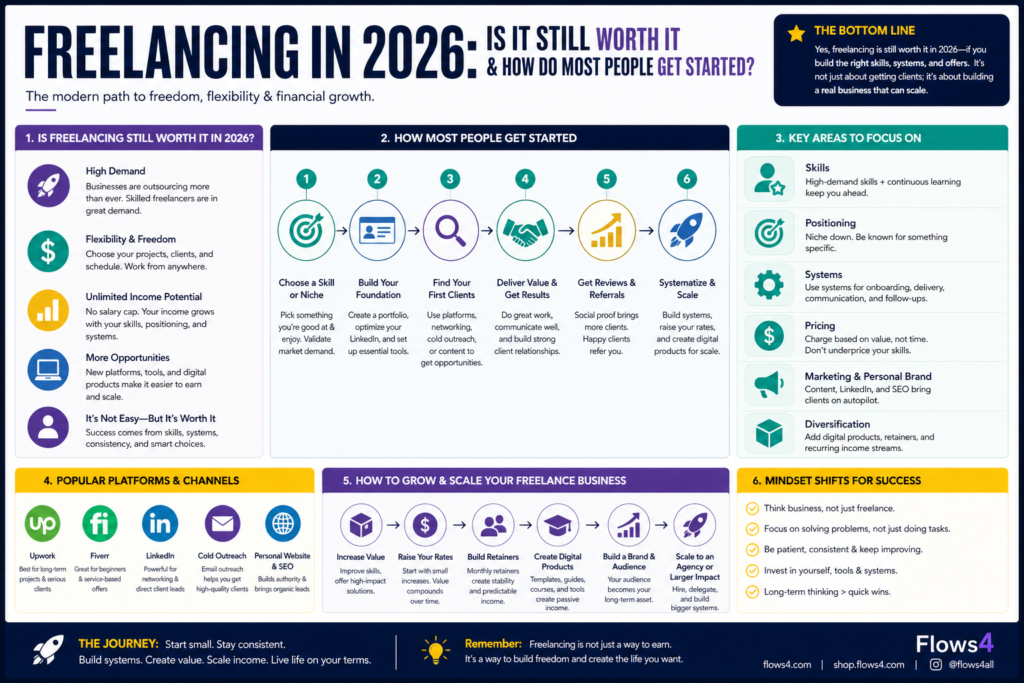
Freelancing in 2026 rewards clarity, consistency, and professionalism.
The freelancers who grow are usually not the smartest.
They are the ones who keep improving the right things.
That is how you stop being a beginner.
And start building a business.
Stop Guessing and Start Growing
If you are tired of beginner freelancer problems and want real momentum, start by fixing your systems and sharpening your offer.
Visit https://flows4.com for practical freelance strategies, workflows, and growth guides built for creators and service providers.
And if you want ready-to-use templates, resources, and tools to help you move faster, explore https://shop.flows4.com.
Freelancing gets easier when your business stops depending on luck.
Build smarter. Grow faster.