Most freelancers do not struggle because they lack skill. They struggle because they lack structure. That’s where freelancing systems become important.
You can be excellent at design, writing, development, consulting, or marketing and still feel overwhelmed if your business runs on memory, sticky notes, and late-night panic. That is where strong freelancing systems make the difference.
Freelancing systems help you move from chaos to consistency. Instead of rebuilding your process for every client, you create repeatable workflows that save time, reduce mistakes, and make your business easier to grow.
The best freelancers do not just deliver good work—they build reliable freelancer systems that handle leads, onboarding, communication, delivery, and follow-up without constant stress.
If you are serious about building a sustainable freelance business, your systems matter just as much as your talent.
You can also explore more creator systems and resources on flows4.com and practical digital tools inside https://shop.flows4.com.
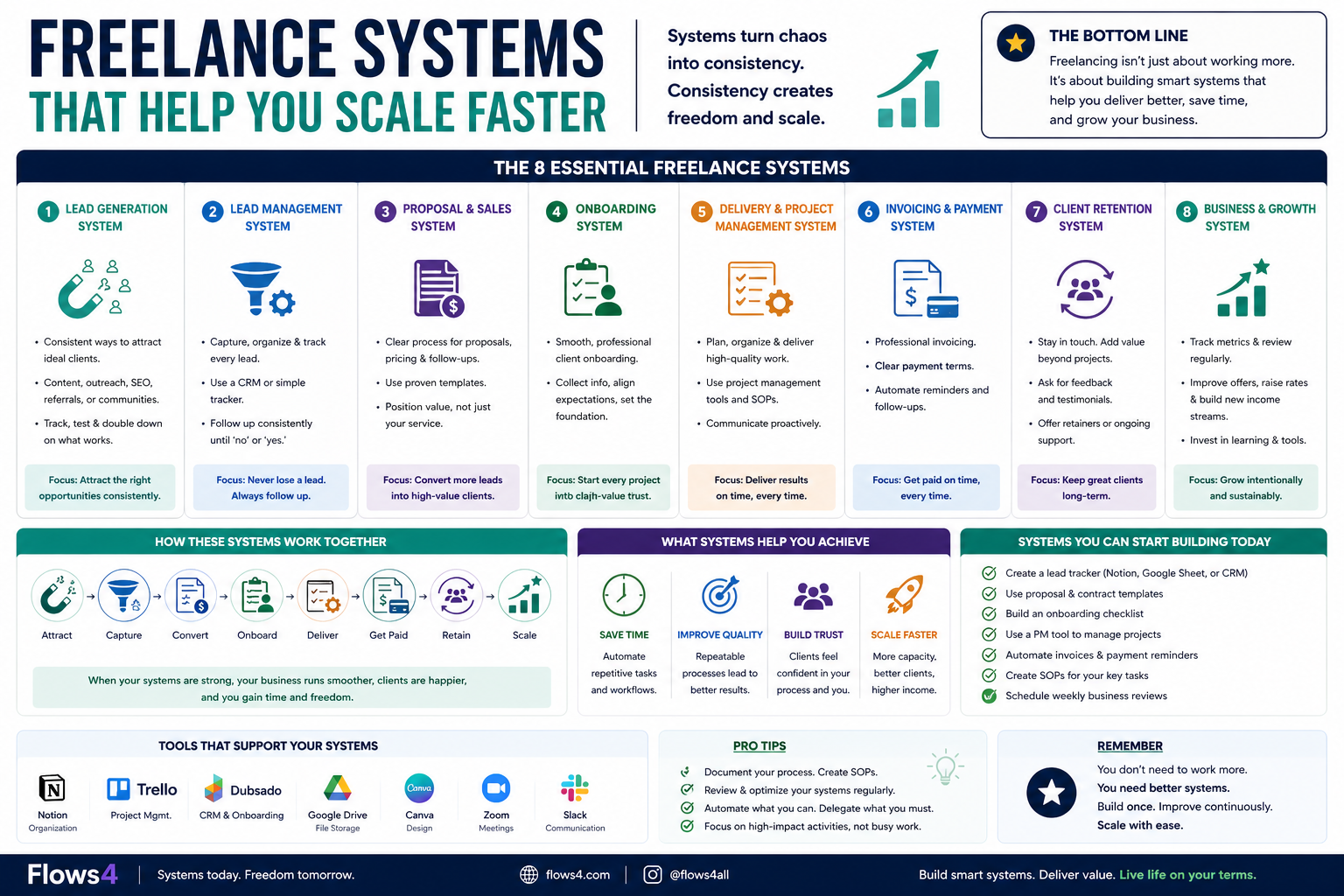
Why Freelancing Systems Matter
Many freelancers start with freedom in mind.
They want flexibility, independence, and control over their income. But without systems, freelancing can quickly turn into constant firefighting.
You forget to send invoices. Client onboarding takes too long. Leads disappear because you forgot to follow up. Deadlines become stressful because files are scattered across different platforms.
This is why freelancing systems are essential.
Strong freelance workflows create predictability. They help you spend less time managing work and more time doing valuable work. They also improve the client experience because everything feels professional and organized.
When clients trust your process, they trust your service.
This is especially important as freelancing becomes more competitive. If you have not read our breakdown on the future of independent work, start with our guide on freelancing in 2026 to understand where the market is heading.
System 1: Lead Tracking and Client Management Systems
A freelancer without a lead tracking system is usually relying on luck.
Someone messages on Instagram. Another person emails. A referral comes through WhatsApp. Before long, opportunities get lost because there is no clear process.
Client management systems solve this problem.
You need one place where every lead is tracked—from first contact to signed project. This can be a CRM, a spreadsheet, or a project management tool.
Your system should track:
- Lead source
- Service requested
- Budget range
- Follow-up dates
- Proposal status
- Closed or lost outcome
This turns random inquiries into a proper sales process.
Freelancer operations become much smoother when you stop guessing who to follow up with.
Even a simple weekly review of your pipeline can dramatically increase conversions.
The goal is not complexity. The goal is clarity.
System 2: A Repeatable Client Onboarding Process
Most freelancers lose momentum right after a client says yes.
Instead of excitement, onboarding becomes messy.
You are chasing information, resending contracts, clarifying scope, and trying to remember what was agreed.
This is where a proper onboarding workflow changes everything.
A strong client onboarding system should include:
- Welcome email
- Discovery questionnaire
- Contract and terms
- Invoice or deposit request
- Project timeline
- Shared communication expectations
- Access to necessary files and platforms
This creates confidence for both you and the client.
It also protects your boundaries. Clear onboarding prevents scope creep and reduces unnecessary back-and-forth later.
We cover this in more detail inside our /client-onboarding-system/ guide because this step is one of the biggest differences between struggling freelancers and scalable businesses.
Freelance business systems should always start here.
System 3: Delivery Workflows That Prevent Bottlenecks
Doing the work is not enough. Delivering the work efficiently matters just as much.
Without delivery systems, projects feel heavier than they should.
Files get misplaced. Revisions become confusing. Communication becomes reactive instead of proactive.
Your freelance workflows should define:
- How projects are structured
- Where files are stored
- How revisions are requested
- When progress updates are sent
- How final delivery happens
- How approvals are documented
This makes delivery smoother and faster.
For example, instead of asking clients “What changes do you want?” you can send a structured revision form. Instead of random WhatsApp updates, you can schedule milestone check-ins.
Small systems create major professionalism.
Freelancer systems are not about removing the human element—they are about removing unnecessary friction.
System 4: Follow-Up, Retention, and Content Systems
Many freelancers focus only on getting new clients.
The smarter move is building systems that keep clients coming back.
Retention is cheaper than constant lead generation.
A strong follow-up system includes:
- Project completion check-ins
- Testimonial requests
- Referral requests
- Upsell opportunities
- Monthly check-in emails
- Educational content that keeps you top of mind
This is where content becomes part of freelancer operations.
If you consistently share helpful content through email, Instagram, or LinkedIn, you create trust long before the next project starts.
That is why we also share practical creator-focused strategies on instagram.
Your content system should support your business, not distract from it.
Simple repeatable content beats random bursts of motivation every time.
Build Systems Before You Need Them
One of the biggest mistakes freelancers make is waiting too long.
They only build systems after burnout.
The better approach is building early.
You do not need enterprise software. You need repeatable habits.
Start with one system:
- Lead tracking
- Client onboarding
- Project delivery
- Client retention
Fix one bottleneck at a time.
Over time, these freelancer systems become your competitive advantage.
Clients notice professionalism. You notice less stress. Your business becomes easier to scale because growth no longer creates chaos.
That is the real purpose of freelancing systems.
Not just efficiency—freedom.
Final Thoughts
Freelancing systems are what separate busy freelancers from sustainable businesses.
Talent gets attention. Systems create longevity.
The freelancers who scale faster are usually not working harder. They are working with better freelance workflows, stronger freelancer operations, and smarter client management systems.
If your business feels messy, the answer is rarely “work more.”
It is usually “build better systems.”
Start small. Improve one workflow. Repeat.
That is how freelance business systems turn survival mode into long-term growth.
CTA: Build Your Freelance System Today
If you are ready to stop running your freelance business on guesswork, start building your systems now.
Visit flows4 for practical strategies, tools, and resources designed for creators and freelancers who want sustainable growth.
And if you want ready-to-use templates, frameworks, and business resources, explore the store and start building faster.
Your freelance business should work for you—not the other way around.